
By Jay Mandel
In a TikTok circulating after Freddie Jackson’s death, he appears in a red-and-black jacket, speaking in front of birthday decorations. His face and neck look very lean. At moments, he smiles. The uploader describes it as his last birthday message, although I have not independently verified when the footage was recorded. [17]
The difference between the man on that screen and the Freddie Jackson I remembered stopped me. I worried about his health. I wondered what performing demanded of him and whether being onstage still gave him more than it took.
His death left me with a question I couldn’t shake.
When is enough enough?
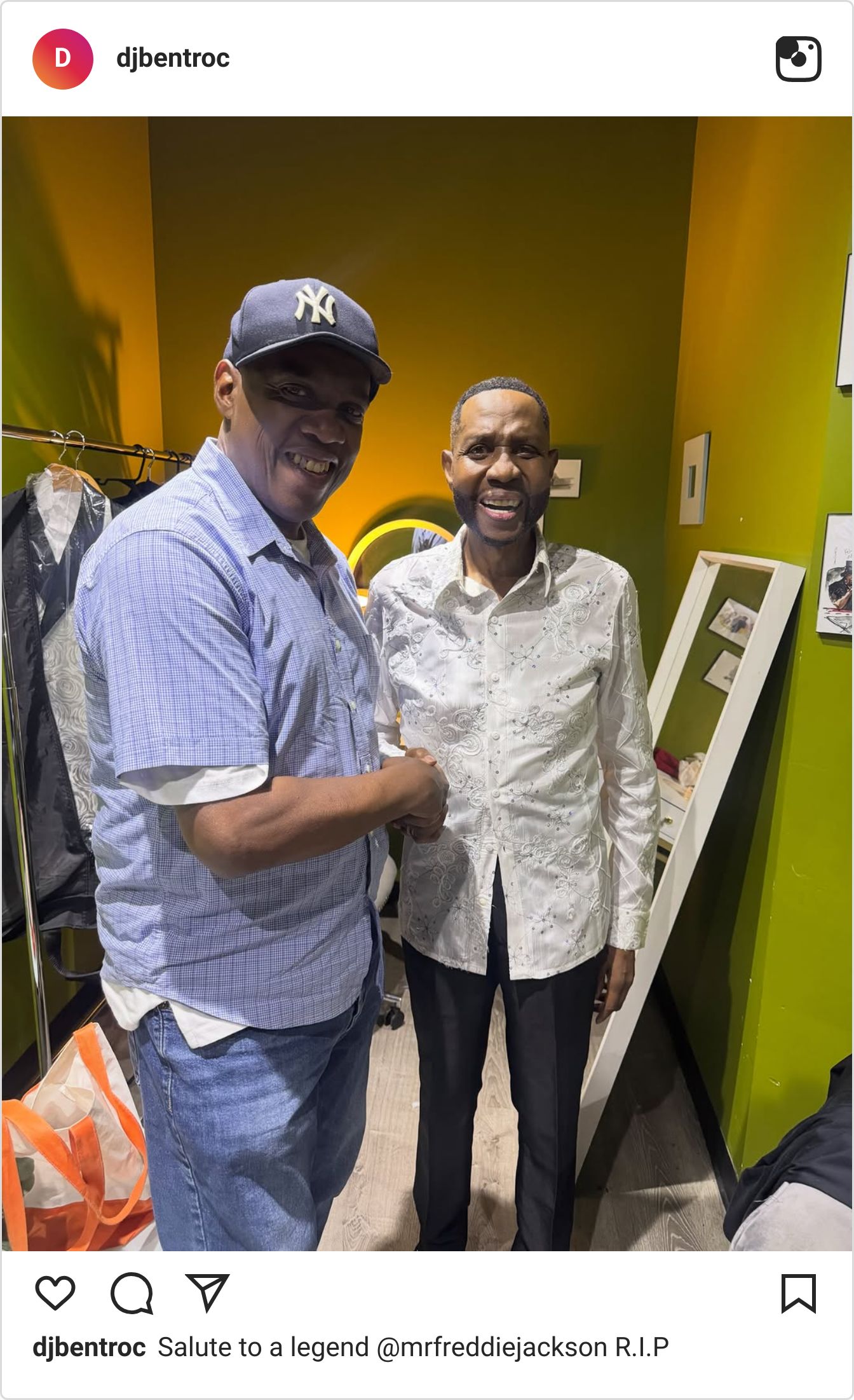
Jackson died on October 5. His family’s announcement did not identify a cause. He had publicly disclosed kidney disease in 2024 and continued his performing career afterward; reporting places him onstage in Philadelphia earlier this year. This was a performer living with a disclosed illness while continuing to work. What we do not know is how severe that illness was at each appearance or what his doctors advised. [1–2]
I could not verify the claim that he performed just days before his death. Some recent bookings were cancelled. The Instagram reel that prompted more questions about his appearance was itself posted in September 2024. It cannot show us what his condition was in his final days. [3–5]
Those limits leave plenty to discuss. How much did working cost him physically? Did he want to keep going? Did he feel he had to? We do not yet have answers.
My bias is toward questioning the expectation that people should keep working because they still can. We celebrate endurance so automatically that stopping can start to look like a failure. For someone whose identity and income were built in front of an audience, that expectation may be especially hard to escape.
Patti LaBelle brings another uncomfortable part of this conversation into view: what happens when a celebrated performer has a difficult public moment?
At the 2023 BET Awards, her tribute to Tina Turner faltered as she struggled with the lyrics to “The Best.” It was an awkward moment on a major stage. BET subsequently said audience members had obstructed her view of the teleprompter. That explanation belongs beside the clip. [7]
Her national anthem at the July 2026 MLB All-Star Game also divided viewers. Some called the performance embarrassing; others praised her voice and defended her interpretation. These were disagreements about a performance. They did not establish a diagnosis or prove she was unable to perform. [8]
Still, I resist the idea that a legendary career makes every current performance beyond criticism. We can respect someone’s contribution and acknowledge a rough appearance. Fans should be able to ask whether a demanding schedule still serves the artist without being accused of disrespect.
The artist’s answer counts, too. LaBelle told the Associated Press in 2025 that she enjoyed performing and regarded being able to continue as a blessing. Meanwhile, Chaka Khan described the Queens Tour she shared with LaBelle, Gladys Knight and Stephanie Mills as demanding. After it ended this May, Khan told People about the intense travel and work. Pleasure and exhaustion can exist in the same career. [9–10]
There is no credible basis in the reporting I reviewed for calling LaBelle’s awkward moments dementia. The question I want to pursue is whether the format, workload and expectations still fit the person doing the work.
Lionel Richie makes the physical cost harder to overlook.
By September 22, ABC News was reporting his third hospitalization that summer. His tour had already been interrupted after he fell ill onstage in June. In late August, he entered a hospital after a St. Louis performance. Then came a September procedure for atrial fibrillation. His representative said the procedure went well and that Richie would take time off before returning to the stage. [11]
Three hospitalizations in a few months should prompt more than interest in the next available ticket.
Who decides what the next stretch of work should look like? How much recovery time is built in? Can the schedule change substantially, rather than simply pause until the same demands resume?
Those questions do not mean Richie ignored medical advice. The public reporting does not establish that. They express my concern about how quickly a health scare can become a comeback story. Recovery should set the timetable.
There is also a business surrounding that body onstage.
Berklee’s description of artist management includes arranging tours, negotiating contracts, developing income and advocating for the performer, including their well-being. Those responsibilities need to work together. A manager’s success should include knowing when a smaller schedule serves the client. [18]
I want to know what happens when the financial case for another show collides with the human case for a break. Who can recommend cancelling without their own income shaping the advice? Does the performer have an independent adviser? What protection does the contract provide if illness interrupts the work?
I have not reviewed these artists’ private contracts or medical records, and I have no evidence establishing that Jackson’s management forced him to perform. That is precisely why an allegation of exploitation would require reporting beyond a troubling clip. But the potential conflict deserves scrutiny before a crisis, while decisions can still change.
Then there is money.
A legendary reputation does not pay the mortgage. Even an enormous income does not guarantee lasting financial security if spending, debts or other obligations keep pace with it.
David Crosby put that plainly in a March 2020 interview with GQ. Facing pandemic cancellations, he said, “If I lose the tours, I probably will lose my home.” He described having no savings and depending on live work for income. That was a celebrated musician explaining a household financial problem. [12]
Willie Nelson’s tax troubles offer another documented example. After the IRS seized his property over a $16.7 million tax debt in 1990, he released The IRS Tapes to help repay it. A 1993 Houston Chronicle interview described his performing work and continuing debt. Nelson also said the pace of recording and touring had hurt his songwriting. The work that generated money could consume time needed to create it. [13]
Mick Fleetwood’s history brings lifestyle into the discussion. A 2014 Men’s Journal profile, reposted on his official website, described his 1980s bankruptcy after failed real estate deals and luxury-car purchases. His success had generated wealth without protecting him from financial collapse. That history illustrates the cost of spending and investment decisions; it does not establish the motive for every later tour. [14]
These are different stories. They show why “surely they have enough money” is an assumption worth checking. They also do not tell us what Jackson, LaBelle or Richie had in the bank.
For some performers, the question may be whether they can afford to stop. For others, it may be whether they are willing to reduce the life their work pays for. A large household, employees, properties and familiar comforts can become ongoing commitments. The practical question is how much work those commitments require—and whether the person still wants that bargain.
The financial vulnerability extends beyond famous names. MusiCares provides assistance with housing, utilities and other basic needs when illness, injury or lost work creates hardship. It also helps with medical costs and offers financial coaching that addresses irregular income and uncertain retirement planning. The industry’s own support system recognizes how easily a health problem can become an income problem. [19]
I would like to see the same seriousness in the way careers are planned: money set aside for time off, honest accounting of what a tour actually leaves the artist, and a workable plan for reducing the workload. A lifetime of earning should not require a lifetime of maximum output.
And then there is the need to remain the person everyone recognizes.
I suspect that can be harder to surrender than a lifestyle. Spend decades hearing your name announced and watching people rise to their feet, and an ordinary Tuesday might feel like a loss of identity. That is a hypothesis about the pull of public life, not a claim to know any particular performer’s private motives.
Howard Stern offers a useful example of negotiating with that pull.
In September, Stern said he had been ready to retire. According to Barrett Media’s account of his broadcast, SiriusXM asked what his ideal job would look like. He proposed coming in one day a week to connect with his audience and crew, with fewer responsibilities. The company agreed. SiriusXM confirms that new live shows now air on Mondays. One broadcast day does not necessarily mean one day of total work. [15–16]
Stern’s explanation centered on time, age and workload. He described wanting more freedom while keeping the part of the job he enjoyed. We do not need to make assumptions about his health to examine that decision.
Part of me hears another famous person finding a way to postpone goodbye. Another part hears someone negotiating a sensible reduction. He kept a connection that he valued and made the job smaller.
That possibility deserves more attention. Could a singer perform fewer dates, travel less, shorten a set or choose a residency? Could a broadcaster keep one show? Could the people around an artist help design a life that includes work without allowing work to consume it?
My concern is what happens when nobody wants to have that conversation. The performer may fear becoming irrelevant. People around them may depend on the income. Fans want another chance to hear the song that takes them back to who they used to be.
I understand the fans. I am one of them. But our attachment to a voice should leave room for the person who has to produce it.
Freddie Jackson’s death does not prove that touring harmed him, and the cause remains undisclosed. It does give me a reason to question the praise we hand out for pushing through, and the discomfort we seem to have with someone deciding they have done enough.
When is enough enough?
For me, the conversation should happen while there is still a real choice. Before every reduction feels like defeat. Before a household depends on a schedule the person can no longer sustain. Before applause becomes another obligation.
A lifetime of work should buy some freedom over the life that remains.
These are the breaks.
Sources
1. Associated Press — Freddie Jackson death announcement; cause undisclosed; kidney disease disclosed in 2024
https://apnews.com/article/freddie-jackson-dies-obit-a83a9d8c7164fd73b99f15fbb97b02eb
2. Inner-City News — reports a June 6, 2026 Philadelphia performance; exact final-performance claim not independently confirmed
https://theinnercitynews.com/freddie-jackson-harlems-hitmaking-rb-crooner-dead-at-70/
3. City Winery Atlanta — September 24, 2026 booking marked cancelled
https://tickets.citywinery.com/event/freddie-jackson-zskz51
4. City Winery Chicago — September 25, 2026 booking marked cancelled
https://tickets.citywinery.com/event/freddie-jackson-ink9zg
5. OG Legacy Culture Instagram reel — visibly dated September 3, 2024; inspected October 7, 2026
https://www.instagram.com/reel/C_dcb-COMVx/?stkn=djBweGc4eXZjb3Ry
6. National Kidney Foundation — kidney disease staging and eGFR; images cannot supply clinical staging evidence
https://www.kidney.org/kidney-topics/estimated-glomerular-filtration-rate-egfr
7. TVLine — June 26, 2023 reporting, including BET statement about obstructed teleprompter
https://www.tvline.com/news/patti-labelle-tina-turner-tribute-bet-awards-2023-explained-interview-1235005400/
8. Us Weekly — July 15, 2026 account of mixed responses to Patti LaBelle’s anthem
https://www.usmagazine.com/sports/news/patti-labelles-all-star-game-national-anthem-divides-social-media/
9. Associated Press — September 2025 interview with Patti LaBelle about performing
https://apnews.com/article/a3746872ad87dd6b0b857abb84a4eff9
10. People — June 2, 2026 interview with Chaka Khan about the Queens Tour’s demands
https://people.com/chaka-khan-shares-why-queens-tour-icons-didnt-hang-out-off-stage-exclusive-11989301
11. ABC News — September 22, 2026 report of Lionel Richie’s third hospitalization and representative’s statement
https://abcnews.com/amp/GMA/Culture/lionel-richie-pausing-touring-due-heart-procedure-rep/story?id=136652159
12. GQ — March 14, 2020 interview with David Crosby
https://www.gq.com/story/david-crosby-coronavirus-touring-interview
13. Houston Chronicle — March 21, 1993 Willie Nelson interview, republished April 24, 2013
https://www.houstonchronicle.com/entertainment/music/article/willie-nelson-q-a-1993-willie-the-hero-4460621.php
14. Men’s Journal profile reposted on Mick Fleetwood’s official website, 2014 — search-indexed text; full-page retrieval unavailable during this revision
https://www.mickfleetwoodofficial.com/2014/fleetwood-macs-mad-hatter-mick-fleetwood-mens-journal/
15. Barrett Media — September 14, 2026 reporting of Stern’s explanation for postponing retirement
https://barrettmedia.com/2026/09/14/howard-stern-retire-siriusxm-convinced-me/
16. SiriusXM — August 31, 2026 announcement of Monday live-show schedule, beginning September 14
https://investor.siriusxm.com/news-events/press-releases/detail/2295/howard-stern-returns-for-new-season-of-siriusxm-show
17. TikTok — @chez.mc birthday-message repost, visually inspected October 7, 2026; original recording date and “last birthday” claim not independently verified
https://www.tiktok.com/@chez.mc/video/7693704774247566614?_r=1&_t=ZT-9AMqnl0B7Wg
18. Berklee — artist-manager responsibilities, including career development and artist advocacy
https://www.berklee.edu/careers/roles/artist-manager
19. MusiCares — financial assistance and financial-coaching programs
https://www.musicares.org/program-category/financial-assistance/